Showing posts with label Animation. Show all posts

Wednesday, October 30, 2013

Online Shorts: Drums West, Mute, Chocolate Bacon, Agamemnon Counterpart, Solipsist


I plan to highlight online short films as a regular feature, and here are five experimental and animated shorts that I've seen and enjoyed over the past few weeks.

Lately my two favorite resources for online shorts have been Mike Everleth's Underground Film Journal and Amid Amidi and Jerry Beck's Cartoon Brew.  I decided to avoid a Halloween-themed list, but if you're looking for one check out Everleth's "Great Underground Horror Films Streaming For Halloween." Yesterday, Cartoon Brew posted an article about the month-long National Film Board of Canada showcase, Get Animated! Both resources are worth following on their respective Twitter feeds and Facebook pages.

The final selection below, along with six other online experimental titles, can also be found in the Cultural Weekly article, "The New Innovators of Experimental Short Cinema" by Amy Cobb.

I prefer to watch online shorts on my television for a better viewing experience, and Plex and its myPlex media queue has become my go-to resource for collecting any online video for later viewing. I first discovered Plex as an app on my Samsung Blu-Ray Smart Hub, and I use it even more extensively with its channel on the Roku Streaming Device.


The procedure is very simple if you first install the myPlex bookmarklet in your bookmark bar, or add the Chrome myPlex Queue Extension. Simply find a video online, then click the bookmarklet to add it to your myPlex queue.  On pages with multiple videos, you might want to go to the video's source page first to make sure you're queueing the right video.  The videos in your myPlex queue are then available to watch on your television using your Samsung Smart Hub app or Roku Channel. Depending on the quality of the video source, the myPlex image and sound quality is very good (although it can take a little bit of time to access the video in your queue).


"Drums West" cut-paper animation from Jim Henson. This newly rediscovered short was created in Jim's home studio in Bethesda, MD around 1961. It is one of several experimental shorts inspired by the music of jazz great Chico Hamilton. At the end, in footage probably shot by Jerry Juhl, Jim demonstrates his working method.


MUTE from Job, Joris & Marieke on Vimeo.
MUTE is an animated short about a world populated by people born without a mouth. When a gory accident leads to the discovery they are able to create their own mouth by cutting themselves, this releases an enthusiastic chain reaction among the population…

This 4 minute cgi short has been created by Job, Joris & Marieke, a Dutch studio for animation, illustration, character design and music. In 2011 Job, Joris & Marieke made the music video 'I'll take you along' for Dutch rapper Gers Pardoel which has been viewed over 15 million times. The music was made by Happy Camper, and all voices were done by Fresku!

MUTE premiered at the Dutch Film Festival in the Golden Calf competition and was screened at the Anim'est festival in Bucarest. More festival news can be found on the MUTE website

http://jobjorisenmarieke.nl/mute


Chocolate Bacon (2012) from asavari kumar on Vimeo.
SYNOPSIS
Chocolate bacon is a portrait of a young woman’s experiences in the first year of grad school, presented through a series of conversations re-contextualized by abstracted characters. The film is divided into 6 episodes showing slices of life from a 7 month time period and the voices are from real audio recordings. The vignettes are interspersed with pieces where the main character talks more specifically about her trials and tribulations in making the film.

WEB : http://asavarikumar.com/chocolate-bacon/

AWARDS AND SELECTIONS
(Innovation Award) No Budget Film Festival ’12 (CA,US)
(Official selection) Ottawa International Animation Festival ’12 (Ottawa, Canada)
(Official selection) Lone Star Film festival ’12 (TX, US)
(Official selection) BUtiful Film festival ’12 (Bournemouth, UK)
(Official selection) Dirt poor filmmakers festival ’12 (NC, US)
(Official selection) Victoria Film Festival ’13 (Victoria, Canada)
(Official selection) Pune International Film Festival ’13 (Pune,India)
(Official selection) Women and minorities in media Festival ’13 (MD, US)
(Official selection) Fort Myers Film Festival ’13 (FL, US)
(Official selection) Toronto Animation Arts Festival International (Canada, 2013)


Agamemnon Counterpart from Michael Robinson on Vimeo.
Original Recipe (made in 2005):

"In 2571 in the heap of crushed stone among the ruins of that not determined turn blue planet it was found video cassette. The fact that you intend to see, has to it no relation. This is completely different record."

Music and character drawings by Jason Kovac aka Dave From 2001 (D2K1).

Free downloadable video game based on Agamemnon Counterpart created by Jason Baum aka Giz/Gizmonicgamer (PC only)-

fileupyours.com/view/127688/Agamemnoncounterpart_gamezFINASH.rar

Another way to watch:

http://www.yooouuutuuube.com/v/?rows=16&cols=16&id=ZqzESY7SIqU&startZoom=1


Saatchi & Saatchi New Directors' Showcase 2012


Wednesday, April 27, 2011

Experimental Animation: Animate Projects Online Exhibition

Animate Projects is a Britsh-based website that supports the production and exhibition of artists' animation by commissioning new work and exhibiting films online and on digital platforms.  They also present short essays on some of the work that they exhibit online, so below I have matched recent videos and essays and their links.


...in a rose colored forest (Edwina Ashton, UK, 2011,4 minutes)
Animate Projects synopsis: …in a rose columned forest is inspired by the books of Edmund and Philip Gosse. Edmund Gosse’s memoir (1907), Father and Son is an account of the childhood he spent with his father, Philip Henry Gosse, the Victorian marine biologist and prolific author. Reading this book led Edwina Ashton to Philip Gosse’s extraordinary scientific writings and illustrations, especially: The Ocean, Evenings at the Microscope, and The British Sea Anemones and Corals. Animate Projects link.

The supplemental essay on the film is by Ingrid Swenson.  The film provides an interesting juxtaposition between the deceptively simple image track a text-dense soundtrack, each of them providing a series of vivid images to contemplate.  While the images at first seem to simply represent scientific data, they soon pick up the connotation of memory and nostalgia. When the narration finally describes a specific image in detail, the effect is quite jarring and somehow moving, as we seem to share the experience of discovery with the narrator.


Figment (Hiraki Sawa, UK, 2011, 10 minutes)
Synopsis by Dale Berning: A boy closes his eyes for 25 minutes and wakes up with the world gone from behind his thoughts. His language slips and shifts, he tastes orange juice without knowing anymore to describe it as sour, he likes numbers but cannot put names to faces. His room is filled with a thousand records and many more. He sees the records, unable to listen. He can't see the floor, has never seen the floor beneath them, wouldn't recognise it if he met it in the street. He meets people in the street and his only option is to trust that they know him when they say they do. His records become opaque, circular slabs of the unknown and the unknowing. A fog of landscapes without contours, without borders, that can only be read by touching. To move forward he must step out, one foot then the other, and believe that he is indeed moving. His mind like an emptied lake, the sky welling upward and outward, unable to contain the depth of it all, the bottomless, fathomless wealth of the things he lost in his sleep. Animate Projects link.

The supplemental essay about Figment is by Coline Milliard. While the synopsis above attempts to describe the film more literally, I think it might be best to engage it as a series of motifs that repeat with very interesting variations.  For example, the concentric circles at some times connote sound waves or ripples, but variations suggest radar screens and music box discs.  These, in turn, can connect to the many records mentioned above, even when we don't see them as spinning circles.  The soundtrack also offers some interesting motifs with various repetitive sounds that at first just seem to irritate but eventually pick up the association with a record skipping.  The film also features a great grainy texture that gives the film a tactile feeling that connects to some of the more visceral sounds and images.


Horse Glue (Stephen Irwin, UK, 2010, 7 minutes)
Animate Projects synopsis: When two films, Horse and Glue, unfold together within the same space, their narratives become intertwined. Horse is a miniature war film that follows a frightened soldier after a bloody battle in which he was the lone survivor. Glue tells the story of a child left to fend for himself in the woods, and is loosely based on The Babes in the Wood folktale.  The stories mix together and the following story is told: a young boy is abandoned in the woods by his father and encounters a murderous child. He is surrounded by a miniature war, puzzled by the actions of a lone, insane soldier and experiences his own mental breakdown. Animate Projects link.


The supplemental essay on Horse Glue is by Angela Kingston.   Again while the synopsis attempts to describe the juxtaposition between Horse and Glue in a more literal and linear manner, I think what makes the film special is the ways in which the films are combined and juxtaposed in terms of visual style.  In the credit sequence the films are juxtaposed through simple cross cutting, but as the film progresses the juxtapositions are achieved through superimpositions and variable-sized screens, producing layers of imagery.  The obvious differences in technique in the two films begins to blur as images and characters begin to echo and resonate with each other.  The tone of the film is pretty bleak and might turn some viewers off, but the film also has an undeniable energy and a strong sense of play. 


Finding the Telepathic Cinema of Manchuria (David Blair, UK, 2010, 10 minutes)
Animate Projects synopsis: A short film which takes the viewer in media res to the discovery of the telepathic cinema of Manchuria, and the reconstruction of its most famous production, a doomed movie known as The Lost Tribes. Animate Projects link.

The supplemental essay on the film is by Emily McMehen.  This is probably best described as a found footage film with an incidental amount of computer animation.  It creates a very dense but lively alternative universe that is a mashup of elements from global politics and cinema history.  The more you know about the the economic and technological history of the cinema, the more you will get out of the transformations in the narrative.  At the same time I'm confident that I'm also missing many direct and indirect references and allusions in the film.  The overwhelming effect is not unlike Craig Baldwin's fake alternative histories like Tribulation 99, and at some point one does suffer from a bit of information overload.  And the density of the information does at times distract you from the genuinely clever use of the found images and footage (I particularly liked the juxtaposition of different images of the same locations).  But the effect is never completely alienating, perhaps because the tone is always kept suspiciously pleasant and calming.

Wednesday, April 20, 2011

Animation: Mad Monster Party (1967) and R.O.D. The TV (2003)

Here are two Animation Quick Picks.  First up is Mad Monster Party, that most of us of a certain age have probably seen at sometime in our youth, but it hasn't been as widely circulated or broadcast in recent years.  The animation style will be instantly recognizable to those who grew up with Rankin/Bass holiday specials such as Rudolph the Red-Nosed Raindeer (1964) and Frosty the Snowman (1969).  Because of the association between Rankin/Bass and holiday specials, many people mistakenly believe that Mad Monster Party is a Halloween special.  Instead it is a feature-length film, not a television special, that parodies several well known movie monsters.  Personally, I haven't seen the film since childhood, and I look forward to adding it to my queue when it begins streaming on Netflix Instant View this Friday, 4/22/11.


Mad Monster Party (Jules Bass, USA, 1967, 95 minutes)
Netflix: Boris Karloff and Phyllis Diller lend their vocal talents to this bizarre stop-motion animated parody of horror films. Dr. Frankenstein makes plans for his retirement and convenes a meeting of all monsters to announce his replacement. As word spreads that the doctor is going to choose his young nephew for the position, the visiting creatures plot a coup d'état that would leave Dr. Frankenstein retired ... permanently. Netflix link.
Begins Streaming 4/22/11


I have also begun watching R.O.D. the TV on Hulu over the past few days.  I caught the later half of the series when it played late nights on G4 several years ago, and it is interesting to go back and finally catch the first half of the series.  While this might seem to be strange praise, what I liked about it the first time around was that I had no idea what kind of fictional world this was supposed to be, but the political reality of this alternative universe slowly revealed itself.  At the time I was also in the dark about the connections to not just one but two previous anime and manga properties.  The Paper Sisters (Michelle, Maggie, and Anita) are from the Read or Dream manga, while the first character we are introduced to, Nenene Sumiregawa, is from the Read or Die manga and OVA anime.  This leads to some jarring revelations if you are not familiar with these backstories, namely that the Paper Sisters are "paper masters" who can manipulate any knid of paper to form a wide variety of objects and weapons.  The Paper Sisters are assigned as bodyguards for the Nenene, and the first few episodes slowly develops their relationships as well as foreshadows the return of the protagonist from Read or Die, Yomiko Readman, who is Nenene's long lost best friend, and an even more powerful paper master than the Paper Sisters.

While Episode 14 explains much of the alternative universe political backstory for the series, suffice to say for now that the central conflict that evolves is between the British Library and the Chinese publishing company Dokusensha, who are battling for control of a series of books that hold the key to global domination.  The Paper Sisters, Nenene, and Yomiko are eventually caught up in this international conflict, even as they try to resolve their more personal and domestic conflicts.  What I like about the show is the interesting mix of tones as the domestic melodrama merges with some quite exciting and dynamic action sequences.  Once you accept the seemingly limitless power of ordinary paper in the hands of the paper masters, the show does reward you with endlessly inventive ways in which the paper masters use that power.  In other words, the show often displays the qualities I associate with great science fiction (though I don't know if this fits in that genre, strictly speaking) in that you learn the rules of the fictional world piece by piece as you watch it, and new twists on your understanding of that world are gradually revealed.  This is true both for the paper masters powers as well as the political reality of the British Library and Dokusensha. As I mentioned before on my earlier entry on Death Note, there are not too many anime series that I have watched from beginning to end, but I look forward to finally catching up with all of R.O.D. the TV in the coming days.
   

R.O.D. the TV (Koji Masunari, Japan, 2003, 26 episodes) 
Anime News Network: Three girls named Anita, Michelle and Maggie are hired to protect Japanese author Nenene Sumiregawa during her stay in Hong Kong. In an incident where the "Paper Sisters" save Nenene from a disgruntled author, Nenene discovers that the sisters have the capability to control paper at their own will - an ability once used by her long-lost friend Yomiko "The Paper" Readman. Arriving in Japan after an airliner incident, the Paper Sisters move into Nenene's apartment and become her freeloading bodyguards. Hulu link.

Thursday, April 14, 2011

Classics: How Many Alice in Wonderlands Are There?

Just how many variations on Alice in Wonderland (and Alice Through the Looking Glass) are there on Netflix Watch Instantly?  Well...this certainly isn't a complete list of all the adaptations ever made (dating back to 1903), but it should keep you busy if you want to see how different filmmakers and stage directors have been inspired by the source material by Lewis Carroll.


Alice (Jan Svankmajer, Czechoslovakia, 1988, 86 minutes)
Netflix: After her stuffed rabbit opens a portal inside her dresser, Alice (Kristýna Kohoutová) crosses over into a world of puppets and dead animals in Czech director Jan Svankmajer's bizarre adaptation of Lewis Carroll's children's book, considered a classic of surreal cinema. Svankmajer gives the Caterpillar, the Mad Hatter and the Cheshire Cat equally warped makeovers via stop-motion animation and stark cinematography. Netflix link.


This is my main inspiration for this entry, so please watch it soon because it expires on Netflix Watch Instantly on April 21.  This is not necessarily for younger kids (they might find it a bit off-putting) and it is a rather loose adaptation of the Alice story (taking Carroll just as a starting point, really).  But it is extremely imaginative and one of Svankmajer's best films.


Alice's Adventures in Wonderland (William Sterling, UK, 1972, 96 minutes)
Netflix: An all-star cast highlights this vibrant musical adaptation of Lewis Carroll's immortal tale. One day, plucky young Alice (Fiona Fullerton) follows a white rabbit (Michael Crawford) down a hole and discovers a world of bizarre characters. She meets mad March Hare (Peter Sellers), enigmatic Caterpillar (Ralph Richardson), Dormouse (Dudley Moore), the haughty Queen of Hearts (Flora Robson), the curious Mad Hatter (Robert Helpmann) and many more. Netflix link.

This has an even more urgent deadline, expiring tomorrow, April 15.  Be warned that Variety called this a major disappointment upon its initial release in 1972, despite the score by John Barry.  The Digital Fix has a more extended review that concludes that this is for "Carroll completists only."  This version does have some fans in the Netflix user reviews, however.


Alice in Wonderland (Dallas Bower, France, 1949, 76 minutes)
Netflix: The charming Carol Marsh stars as Alice alongside a cast of marvelous puppets created by renowned puppeteer Louis Bunin in this acclaimed 1950 adaptation of Lewis Carroll's tale of curious characters and strange happenings down the rabbit hole. Directed by Dallas Bower and featuring superb musical numbers, the wonderfully eccentric film also stars Pamela Brown, Felix Aylmer, Ernest Milton and Stephen Murray. Netflix link.

This version was not widely seen in the United States initially due to a legal dispute with Disney, who of course had their own animated version in the works at the time.  The animation components were designed by stop-motion pioneer Lou Bunin, who was a casualty of blacklisting in the 1950s.  Despite the fact that Alice is supposed to be 7 1/2 years old, star Carol Marsh was 20 years-old at the time (perhaps setting a precedent for the 19-year-old Alice in the 2010 version).


Alice in Wonderland (Kirk Browning, USA, 1983, 87 minutes)
Netflix: Part of PBS's "Great Performances" series, this musical version of Lewis Carroll's classic story features Richard Burton as the White Knight and Burton's daughter, Kate, as the eponymous girl who wanders into a surreal world. A host of stars includes Maureen Stapleton as the White Queen, Eve Arden as the Queen of Hearts, Donald O'Connor as the Mock Turtle, Colleen Dewhurst as the Red Queen and Nathan Lane in an early role as the Dormouse. Netflix links.

This was a television studio re-creation of a revival of Eva Le Gallienne's 1932 stage adaptation, which is considered to be the inspiration for the 1933 all-star Paramount film adaptation.  According to DVD Journal, much of the music in this version comes from a 1947 Broadway revival.


Alice Through the Looking Glass (John Henderson, UK, 1998, 83 minutes)
Netflix: Once upon a time, Alice traveled to Wonderland. Now, she takes another journey and meets up with Tweedledum and Tweedledee, Humpty Dumpty, the Red King and Queen, Red and White Knights and Jabberwocky. Join the intrepid Alice on a magical adventure. Kate Beckinsale, Ian Holm and Penelope Wilton star in this live-action adaptation of Lewis Carroll's classic, directed by John Henderson. Netflix link.

This is one of the few stand-alone adaptations of Alice Through the Looking Glass, the source of Jaberwocky and Tweedledee and Tweedledum.


Alice in Wonderland (Nick Willing, USA, 1999, 133 minutes)
Netflix: Lewis Carroll's remarkable children's tale comes to life in an exciting live-action feature. After Alice (Tina Majorino) follows a talking white rabbit into a strange world where everything isn't as it seems, she befriends a strange array of characters brought to life by Jim Henson's creature shop. The all-star cast includes Robbie Coltrane, Whoopi Goldberg, Ben Kingsley, Christopher Lloyd, Pete Postlethwaite, Miranda Richardson and Martin Short. Netflix link.
Variety praises the animatronic and computer effects by the Jim Henson Creature Shop, but pans the acting in this Hallmark Entertainment adaptation.


Alice in Wonderland (Tim Burton, USA, 2010, 108 minutes)
Netflix: A 19-year-old Alice (Mia Wasikowska) journeys through Underland, where she experiences strange ordeals and encounters peculiar characters, including the vaporous Cheshire Cat (voiced by Stephen Fry), the Mad Hatter (Johnny Depp) and the sadistic Red Queen (Helena Bonham Carter). Anne Hathaway, Alan Rickman, Matt Lucas and Crispin Glover co-star in this inventive, Golden Globe-nominated adaptation of the Lewis Carroll classic. Netflix link.

I think the jury is still out on this most recent version, with a wide variety of mixed responses.

In my brief research for this entry, the one additional adaptation that I think I'd like to pursue on DVD is Jonathan Miller's 1966 BBC adaptation, Alice in Wonderland. Scott Thill explains in Bright Lights Film Journal that Miller's adaptation plays down the spectacle, which might make an interesting corrective to the Burton version.

Wednesday, April 13, 2011

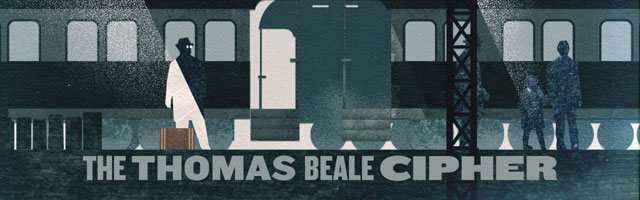
Animation: The Thomas Beale Cipher and Other Animated Shorts Online

Here's a quick survey of some animated shorts that I've come across, often with the aid of Cartoon Brew and The Short of the Week.


First up is The Thomas Beale Cipher by Andrew S. Allen, who in addition to being a filmmaker is also the co-founder of The Short of the Week.  There are two reasons to look at the film, beyond the quality of the film itself.  First, in their initial entry on the film, The Short of the Week provides some information about their new series, The Short of the Week Presents, which will debut films online and help coordinate their digital launch.  In their second entry on the film, they detail their own digital launch plan, and explain how it related to their more conventional film festival distribution and exhibition plan.  The later entry is particularly useful to filmmakers eager to learn how to maximize their presence and impact on the web.


The Thomas Beale Cipher from Andrew S Allen on Vimeo.


Here's a survey of other shorts I've seen and enjoyed over the past few weeks.


Thursday from Matthias Hoegg on Vimeo.


Old Fangs from adrien merigeau on Vimeo.

Wednesday, April 6, 2011

Animation: Toy Story 3 and Pixar on Netflix Watch Instantly

I usually try to pick films that you don't realize are available for viewing on streaming services or on the internet, but today I'll point out a film that you probably already know about.

Toy Story 3 (Lee Unkrich, USA, 2010, 102 minutes)
Netflix: In this installment of the Pixar animated franchise, toy cowboy Woody (voiced by Tom Hanks), his astronaut pal, Buzz Lightyear (Tim Allen), and their friends cope with their owner's departure for college -- and their new home in a day-care center. Joan Cusack, John Ratzenberger, Don Rickles, Michael Keaton and Ned Beatty also lend their voices to this delightful sequel that earned a Golden Globe Award and an Oscar for Best Animated Feature Film. Netflix link.


I think Toy Story 3 is a great film, so by all means watch it if you haven't already.  So instead of writing about the film itself I thought I'd lead you to some links related to some interesting discussions about the film and the nature of current journalistic film criticism and so-called fanboy culture.

As you may know, Toy Story 3 received almost universal critical praise, and the series as a whole almost achieved a perfect 100% rating across the board at Rotten Tomatoes.  But the third film finally got a negative review from New York Press critic Armond White, which can be read here.  The fallout from that review, and its impact on the Rotten Tomatoes rating has been interesting.  Pixar fanboys, in particular, reacted very strongly against White's review, even leading to a petition to ban his reviews from the Tomatometer ratings system.  Coverage of this response can be found at the Wall Street Journal, Pajiba, and Something Old, Something New.

A whole separate post could be dedicated to a discussion of Armond White's work in general, but for now I'll just suggest reading Roger Ebert's withdrawl of his general defense of White after defending his review of Project 9, and this great meta-review of White's Toy Story 3 review by Paul Brunick in Slant Magazine.  But more important to me that whether White is a good critic or not is how this controversy reflects how films are currently discussed in the age of the internet.  To my mind, I'd much rather have people read individual critics like White (and agree or disagree) than to have them believe that they understand the quality of a film based upon the Tomatometer rating.  The Tomatometer is a helpful tool, but one thing that it is not designed to measure is perfection (again, refer to the Pajiba entry in regards to how the Tomatometer numbers are calculated).  Far more troubling to me than the idea that someone didn't like Toy Story 3 is the assumption that aesthetics are quantifiable, and that there is a tangible difference between a Tomatometer rating of 100% and 99%, (which is where Toy Story 3 is right now, with 246 fresh ratings and 3 rotten ratings).

Once you're finished with Toy Story 3, you might want to check out the other Pixar feature currently playing on Netflix Watch Instantly, Up (Pete Docter, Bob Peterson, USA, 2009, 96 minutes), as well as the following documentary on Pixar produced in 2007.  Below that I've embedded an amusing Disney promotional film about the making of Snow White and the Seven Dwarfs.


The Pixar Story (Leslie Iwerks, USA, 2007, 88 minutes)
Netflix: Go behind the scenes at Pixar Animation Studios with this Emmy-nominated documentary tracing the creation and history of the groundbreaking company and featuring interviews with founders Ed Catmull, John Lasseter and Steve Jobs. Assembling rare Pixar footage and conversations with animators, producers, directors and voice actors, Oscar-nominated filmmaker Leslie Iwerks takes viewers on a fascinating tour of the outfit that forever changed Hollywood animation. Netflix link.


Wednesday, March 16, 2011

Animation: Archer, FLCL, and Cartoon Brew

Here's another quick set of recommendations for recent animated television series and some interesting animated shorts. 

Archer: Season One on Netflix
Archer: Season Two on Hulu
Netflix: Set amid the world of international espionage, this irreverent animated comedy from the FX network revolves around the exploits of smart-mouthed superspy Sterling Archer (voiced by H. Jon Benjamin) -- code name: "Duchess." For Archer, taking on top-secret missions around the world is a breeze compared to dealing with his fellow agents, notably his overbearing mother, Malory (Jessica Walter), and his ex-girlfriend Lana (Aisha Tyler).

Archer is the latest series from Adam Reed, best known for his work on Cartoon Network Adult Swim series such as Sealab 2021 and Frisky Dingo.  Archer also features the voice talents of H. Jon Benjamin, a veteran of such series as Home Movies (Coach McGuirk), Dr. Katz (Ben) and another current series, Bob's Burgers (Bob Belcher).

Some may object to this recommendation in an animation entry since Archer might qualify as what Chuck Jones called "illustrated radio" (in reference to stiff Hanna-Barbera television animation). But what can I say...I think this is a funny, entertaining show.  A good short interview with Archer creator Adam Reed can be found at The Onion's A.V. Club


FLCL on Hulu
Edit 4/23/11: FLCL on Netflix Watch Instantly
Hulu: Naota's a bit quirky, but he can still pass for normal. Haruko's totally quirky and she'll never pass for normal. When she runs over Naota with her motorscooter and brains him with a bass guitar, his world doesn't get turned upside down - It gets incredibly weird. There's nothing else in the world like FLCL. This one's going to change your life.

In contrast with Archer, FLCL is often jarring in its often flamboyant and over-the-top animation style.  Currently Hulu has only the first two episodes out of the total of six episodes.  In the event that Hulu does not end up posting the remaining episodes, the series was just re-released on DVD and Blu-ray last month.


Animation historians Jerry Beck and Amid Amidi have a wonderful website devoted to animation at Cartoon Brew.  In addition to being a wonderful resource for animation history and recent animation news, the website also has a feature called CBTV, which showcases recent animated shorts, often from student filmmakers.  I encourage you to bookmark their website and continue to check in for new work; meanwhile, here are a few of my favorites from their recent posts.


“The Cyclotrope” by Tim Wheatley


The Cyclotrope from tim Wheatley on Vimeo.

“Hotcorn!” by Juan Pablo Zaramella


Hotcorn! from Juan Pablo Zaramella on Vimeo.

“Inception” in 60 seconds, with paper cut-outs by Wolfgang Matzl


“One Minute Puberty” by Alexander Gellner


One Minute Puberty from bitteschön.tv on Vimeo.


“Orpheu’s Pony” by Michael Fragstein


Orpheus´ Pony from Michael Fragstein on Vimeo.

Wednesday, March 9, 2011

Independent Animation: Suzan Pitt, Robert Breer, Jeff Scher, Paul Glabicki,

Here's just a quick tour of some independent and experimental filmmakers whose work you should know, if you don't already.


The Films of Suzan Pitt: El Doctor / Joy Street / Asparagus (Suzan Pitt, USA, 1979-2006, 64 minutes)
Netflix: This collection of short films showcases the originality of Suzan Pitt's strange yet beautiful animation, which has enchanted audiences for three decades. The surreal "El Doctor" tells the tale of a Mexican physician who goes on a twisted journey. Next, in "Joy Street" a woman travels from the depths of depression to happiness with the help of an unlikely guardian angel. Finally, "Asparagus" takes viewers on a vivid, sexually charged nightmare. Netflix link.

Pitt is probably most well known for her short, Asparagus, which opened for David Lynch's Eraserhead when that film crossed over into the Midnight Movie circuit in the late 1970s and early 1980s.  But her subsequent work has been featured at the New York Film Festival and the Sundance Film Festival, and she has had a career retrospective at the Museum of Modern Art.  More recently, she has been an instructor at Cal Arts.  All of this and more is discussed in a helpful interview with Pitt that can be downloaded (as a .doc file) here; the interview originally appeared in the Society for Animation Studies Newsletter.  Netflix user comments indicate that some viewers might have technical difficulties watching all three films, but they are indeed streaming so if nothing works hit the individual play buttons on the webpage.
 

Robert Breer on UbuWeb: http://www.ubu.com/film/breer.html
All of Robert Breer's films are great, but my particular favorites available on this page include Fuji (1974), LMNO (1978), and TZ (1979).  Breer has had a lasting influence on subsequent generations of animators and experimental filmmakers, as can be seen in this insightful essay on Breer by animator George Griffin.  The following passage from Griffin is a good introduction to Breer's work:

It is impossible to see Breer’s films without being reminded of the art world movements and ideas that influenced him: Dada’s anarchy, Abstract Expressionism’s action, Pop’s appropriational fun, Minimalism’s severity. Yet this heady mix is often tossed up with snatches of cartooning as children, rats, pocket knives, cats and nudes tumble through the timescape. How do we interpret these icons? Are they aspects of a personal narrative, breathing the complications of familial life and love? Symbols of a footloose nation teetering nonchalantly between war and peace? Illustrations of what art critic Harold Rosenberg called the “anxious object”? Or, as William Carlos Williams put it, “No ideas but in things”?

Breer's emphasis on the graphic elements of the image (shape, size, movement, and color) allows him to shift back and forth between pure abstraction and stylized representation.  This is perhaps best seen in Fuji, where the easily recognizable representation of the Japanese mountain is re-worked and re-formed in various degrees of abstraction.  Somehow we are able to appreciate both the formal properties of the image as well as the literal and connotative meanings associated with the image.  Thus, what might seem at first to be mundane travel home-movie footage in Fuji is transformed into a fascinating work, one that teaches us how to see the world differently. 

While different than Breer in their degree of formal rigor (and different from each other in important regards) the following two filmmakers, Jeff Scher and Paul Glabicki, can be seen as working in the tradition started by Breer and other experimental animators.


Jeff Scher's The Animated Life Blog: http://opinionator.blogs.nytimes.com/category/jeff-scher/ 

New York Times Bio:  Jeff Scher is a painter and experimental filmmaker. His work is in the permanent collection of numerous museums, among them the Museum of Modern Art, and has been screened at film festivals around the world, including opening night at the New York Film Festival. He has also created work for HBO, PBS, the Sundance Channel and, most recently, a music video for Bob Dylan. A selection of his films, "The Best of Times," was just published as an iPhone and iPad app. Mr. Scher teaches at the School of Visual Arts and at N.Y.U. Tisch School of the Arts. Music for Mr. Scher's videos in The New York Times are by Shay Lynch.

Scher's short films are a pure delight.  They balance great craftsmanship with a sense of play with the materials that produces a very personal visual style.  Like Breer, Scher is able to transform everyday observations into kinetic visuals that teach us not to take the mundane for granted.  Sometimes there seems to be a quiet desperation in his attempts to keep memories vivid as he and his wife and child grow older.  Along these lines, You Won't Remember This, You Won't Remember This Either, and In Your Dreams are particularly beautiful films.  For more information on Scher, you can also go to his personal website, Fez Films, here.


Paul Glabicki on UbuWeb: http://www.ubu.com/film/glabicki.html

I wasn't as familiar with Glabicki's work until putting this entry together, but his interest in formal concerns and the relationship between representation and abstraction in films like Diagram Film from 1978 places into the tradition I've associated here with Breer and Scher. 

His work has been featured at most of the important North American experimental film festivals, such as the Ann Arbor Film Festival, Black Maria Film and Video Festival, and the San Francisco Art Institute Film Festival.  In addition to receiving a Guggenheim Fellowship, he has also received support from the National Endowment for the Arts and the American Film Instutute.


I look forward to your reactions and feedback in the comments section.  --JLK


Wednesday, March 2, 2011

Animation: Anime Features & Stop Motion Shorts

This is not by any means an exhaustive list of anime features available on Netflix View Instantly. These are some simply titles that caught my eye recently and that I'd like to share.  If you have other suggestions, please share links to them in the comments section.

 
The Place Promised in Our Early Days (Makoto Shinkai, Japan, 2004, 90 minutes)
Netflix: In this animated film, Japan is under two regimes after the country's loss in World War II. Hokkaido remains under Japanese rule while America holds the rest, a bitter division that's wrenched the nation and left its citizens confused. Curious, Sayuri and her pals decide to build a vessel that would help them investigate a looming tower in Hokkaido, a plan they abandon when Sayuri falls ill. Is there a connection between her coma and the tower? Netflix link.

First, it must be said that the Netflix description is a bit misleading; one might think that it is set in an alternate reality in the immediate aftermath of World War II.  Instead, it is set in the near future within that alternate reality (there are laptops, modern cars and equipment, etc.). I don't want to say much more about the details of this alternate reality because part of the pleasure of the film is figuring out how the interpersonal stories that are central to the plot fit into this alternative political landscape.  The characters talk as if everyone knows the basics about this reality, which is challenging sometimes but fun to work out. (Anime News Network lists the date as 1996, which is plausible if you assume a faster rate of technological change in this alternate reality.  The Hokkaido Tower couldn't be built now, let alone 15 years ago.)

That said, one often forgets the alternate reality component of the film because the first third focuses so meticulously on the relationship between two young boys and a girl, Hiroki, Takuya, and Sayuri. Although it perhaps depends a bit too heavily on tropes common to coming-of-age anime (including the sound of cicadas, all too familiar to fans of Neon Genesis Evangeleon) the relationships develop at a leisurely pace and the film conveys a tranquility that is clouded by a threat that the kids do not yet understand: the Hokkaido Tower that hovers over them.  Once they engage that threat the film becomes somewhat more conventional, but still engaging and often quite gorgeous.

In terms of style, it is an interesting mix of what some people call the limited animation associated with anime and extreme attention to the textures created by different kinds of light.  So-called limited animation became the norm in Japanese animation for various reasons, but once it was established as a norm some animators began to play with the style beyond mere cutting-corners.  In this regard it is interesting to compare the original Neon Genesis Evangeleon television series with the current "rebuild" films.  In the new films, the sequences that have changed most radically to incorporate new computer animation technologies are the battle sequences.  Instead of re-conceiving the overall style of the film, the main narrative scenes are done in much the same style of the old show, with the important addition of light, shade, and texture effects that are now possible with animation software.  A similar interest in light and texture can be seen in The Place Promised in Our Early Days, sometimes with dazzling results.

For example, there is conversation between Hiroki and Sayuri on a train that is composed as a long shot in which the ceiling of the train car dominates the frame and the two characters are in the lower half of background.  Cynics who emphasize the word "limited" in limited animation would say that this is just cutting corners, keeping a relatively static frame for a conversation that is conveyed almost as a voice over.  But there's more going on here, as the salient property of the shot becomes not the conversation but the play of light as it refracts and reflects on the surfaces of the train's interior.  The so-called limited animation enables this kind of play with texture.


Dead Leaves (Hiroyuki Imaishi, Japan, 52 minutes) 
Netflix: After awakening on Earth with no recollection of who they are or how they got there, otherworlders Pandy and Retro go on a crime spree. But they're soon apprehended and sent to Dead Leaves, a high-tech prison on the moon, and discover that the facility is also used for cloning and bizarre genetic experiments. Before long, the duo enlists the aid of their deformed fellow inmates in an attempt to escape from the prison. Netflix link.

I'd rather that you just hit play and see if this is for you--you will know almost immediately. If you're game this is quite a trip.  Netflix View Instantly also has volume one of Imaishi's mecha series, Gurren Lagann, which Anime News Network called "one of the liveliest series of the decade."


Ponyo (Hayao Miyazaki, Japan, 2008, 103 minutes)
Netflix: This Japanese anime feature from famed filmmaker Hayao Miyazaki follows the adventures of a 5-year-old boy, Sosuke, and his burgeoning friendship with Ponyo, a goldfish princess who desperately wants to become human. After running away from and then being recaptured by her strict father, Ponyo -- with some help from Sosuke -- becomes more determined than ever to make her dreams come true. But will her wishes throw the entire earth off balance? Netflix link.

Hopefully I don't need to introduce you to the work of Hayao Miyazaki.  If you're unfamiliar with his work, take the plunge with this or with any of his classics. Possibly the best fan site is The Hayao Miyazaki Web, which is a fine starting point for the uninitiated.  Ponyo is absolutely charming and has some genuinely exhilarating sequences.  Netflix View Instantly also has his earlier work, The Castle of Cagliostro, which is good, but less typical of his work and related to the Lupin the 3rd manga and anime television series.


Wednesdays will also feature animated shorts and experimental films.  Below are two recent stop-motion short films.


Bottle (Kirsten Lepore, USA, 2010, 5.5 minutes)
Vimeo: Animated on location at a beach, in snow, and underwater, this stop-motion short details a transoceanic conversation between two characters via objects in a bottle. Vimeo link.

Lepore has found success on the film festival circuit with her film, Bottle.  She won a prize for Best Animated Short at the Slamdance Film Festival and Best Student Film at the Anim’est International Animation Film Festival. She was a finalist for the first Vimeo Awards, and the film has been featured at the AFI Film Festival. Thanks to Bad Lit for showcasing this film.


Bottle from Kirsten Lepore on Vimeo.


Big Bang Big Boom (Blu, 2010, 10 minutes)
Vimeo: An unscientific point of view on the beginning and evolution of life ... and how it could probably end. Direction and animation by BLU. Production and distribution by ARTSH.it. Soundtrack by ANDREA MARTIGNONI. Vimeo link.

I thought about posting this in my Banksy-related post last week, but thought it would be more appropriate to feature it in an animation post.  You should also check out Blu's other short from a few years ago, Muto.


BIG BANG BIG BOOM - the new wall-painted animation by BLU from blu on Vimeo.


I look forward to your feedback and comments.  --JLK

Wednesday, February 23, 2011

Animation: Not Always for Children

I have now discovered that it will be more difficult to do an animation entry each week due to the way Netflix organizes its categories.  Pixar, for example, is under “Children & Family” but is not cross listed in “Anime & Animation,” which is reserved more or less for just anime.  In any event, we’ll have a short entry today with a feature film and a few shorts films.

We'll start off with some more obvious choices, and in the coming weeks I will dig a bit deeper to link to lesser known films.


Netflix: In rustic 1957 Maine, 9-year-old Hogarth finds a colossal but disoriented robot (of unknown origin), and the two form a strong bond of friendship. Before long, however, a government agent is on their trail -- and he's intent on destroying the automaton. This beautifully rendered parable based on British poet Ted Hughes' feted short story features the voices of Jennifer Aniston, Vin Diesel, Harry Connick Jr. and Cloris Leachman. Netflix link.

I had the pleasure of seeing this with my nephews during its theatrical release, and I've always been disappointed that it hasn't received more attention over the years.  It has been associated unfairly with the so-called demise of cel animation in favor of computer animation in feature filmmaking (which is a debatable premise in the first place).  Director Brad Bird, of course, has gone on to great success with Pixar (The Incredibles and Ratatouille), but that just serves to show that Pixar's success is just as much about talent and storytelling as it is about technology.  If you've been frustrated with the repetitiveness and limited story and character range of recent computer animated features (Despicable Me and Megamind come to mind), take a chance on Iron Giant and remind yourself that in the right hands cel animation is still capable of great storytelling power.

Perhaps what is most amusing about the Netflix user comments for Iron Giant is the anger that some parents express over the use of the word "hell" in the film ("Imagine my shock when I heard...").  As sensitive as I am to the needs of parents, if this weren't an animated film and were simply any PG-rated film, the outrage would seem more than a bit odd.  Unfortunately the default assumption by most people is that anything that is produced using animation is obviously produced for children and therefore must be rated G.  

The remaining picks this week are not what most would consider to be family friendly, but I hope to feature a range of animated styles and content in the coming weeks.  I'll assume that not everyone automatically associates animation with children and family fare.   


Hulu: Light Yagami is an ace student with great prospects and he's bored out of his mind. But all that changes when he finds the Death Note, a notebook dropped by a rogue Shinigami death god. Any human whose name is written in the notebook dies, and now Light has vowed to use the power of the Death Note to rid the world of evil. But when criminals begin dropping dead, the authorities send the legendary detective L to track down the killer. With L hot on his heels, will Light lose sight of his noble goal...or his life? Netflix link.  Hulu link.


This past summer I finally took the plunge and worked my way through this well respected anime series, which has inspired live action adaptations and other spin-offs.  I was always intrigued by the series when I would catch it from time to time on Adult Swim, but it is immediately obvious when trying to catch it in the middle that you need to start the series from the beginning.  While I would recommend pacing yourself with the series (otherwise it might get repetitive and frustrating if you watch it all at once), I have to admit that I did get very involved with the characters, and the twists and turns of the plot.  If you allow yourself to buy into the premise of the story (which might take an effort for some viewers) there are several very suspenseful episodes, particularly in the middle (with the match of wits between Light and L) and near the end.  While there are some anime series that I enjoy, the only other anime series that I've watched from beginning to end has been Neon Genesis Evangelion (and I've been trying to keep up with the rebuild films as they've become available).  While Death Note is not as philosophically intriguing as Evangelion (although at times it tries to be), it is certainly one of the better series (of any kind) available in its entirety on Hulu.


A boy learns to play the piano.  Vimeo link.

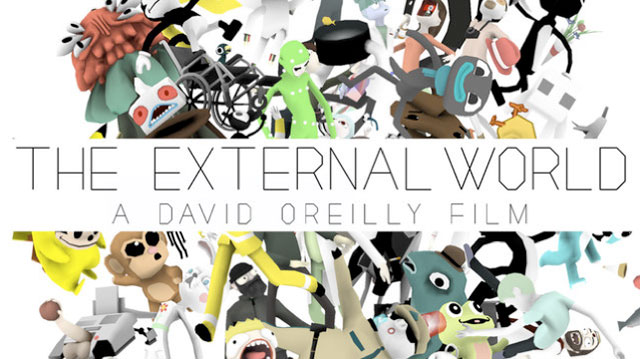
O'Reilly is an intriguing computer animator born in Ireland and currently working in Berlin, Germany.  I first came across his work with Please Say Something, which found success on the festival circuit (including the Cucalorus Film Festival here in Wilmington, NC).  The External World doesn't have the same range of emotional tones as Please Say Something, but it is a very funny series of sometimes violent and politically incorrect gags and comic scenes (note: this is "Not Safe for Work," as they say).  It is hard to sustain a 17-minute running time with such a loose structure, but there is enough absurd comic energy to keep the audience engaged as long as they are not offended (which they shouldn't be).  My favorite thread of action within these scenes involves a character who finds happiness after receiving a special prescription from his physician; the prescription doesn't really solve anything, but everything seems to be so much better.  The bleak world view and skepticism about any easy answers that pervades the film is balanced by the way it reminds us of the absurdity of what we might call suffering.


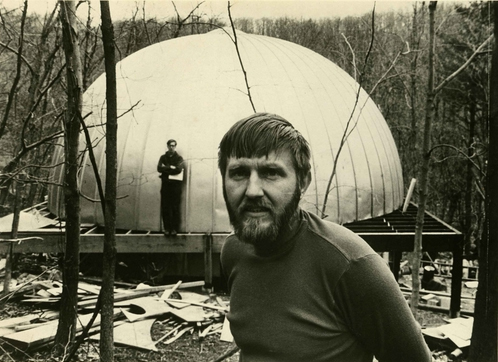
EAI Online Catalogue: A pioneer in the development of experimental film and live-action animation techniques, Stan VanDerBeek achieved widespread recognition in the American avant-garde cinema. An advocate of the application of a utopian fusion of art and technology, he began making films in 1955. In the 1960s, he produced theatrical, multimedia pieces and computer animation, often working in collaboration with Bell Telephone Laboratories. In the 1970s, he constructed a "Movie Drome" in Stony Point, New York, which was an audiovisual laboratory for the projection of film, dance, magic theater, sound and other visual effects. His multimedia experiments included movie murals, projection systems, planetarium events and the exploration of early computer graphics and image-processing systems.  UbuWeb Link.


I hope to highlight experimental filmmakers on Wednesdays as well as animators, and in coming weeks I hope to focus on more contemporary work.  But for now I will just encourage you to explore the work of Stan VanDerBeek, whose range of work went beyond the collage animations I will focus on here.  My personal favorites include Science Friction (1959), Achooo Mr. Kerrooschev (1960), and Breathdeath (1963).

I look forward to your thoughts on all of these films in the comments section.  --JLK